Tag: Lord Shiva

  • Patteeswaram Thenupuriswarar Temple

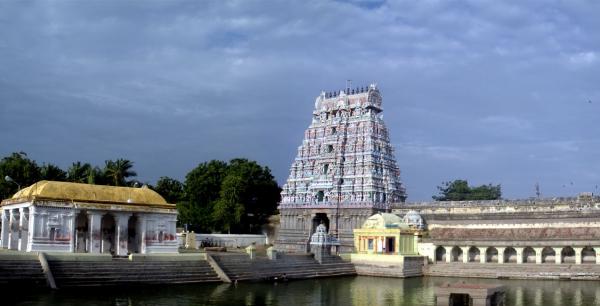
    Thenupuriswarar Temple is a temple dedicated to the God Shiva located in the holy village of Patteeswaram. Patteeswaram is situated at a distance of about 8 kms from Kumbakonam. Main deity of this temple is called Patteeswarar or Thenupuriswarar and his consort Goddess Parvati is called, Gnanambigai or Palvalainayagi. This temple is also famous for the worship of Mother Durga.
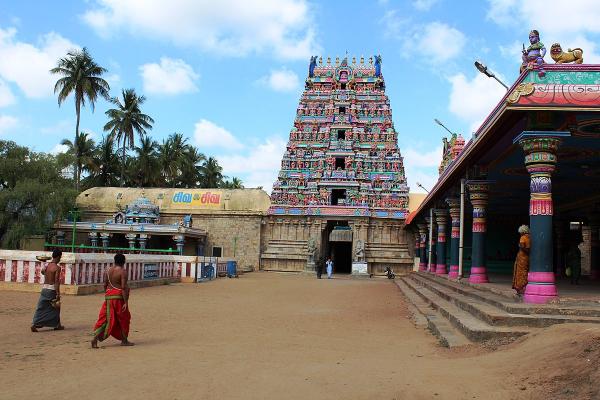
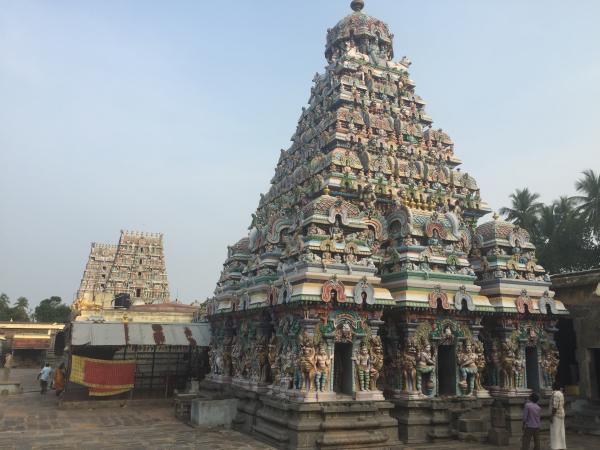
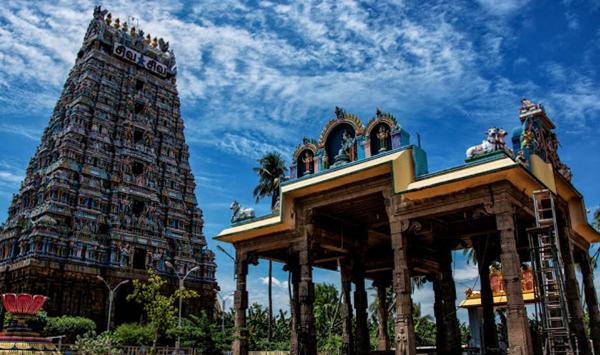
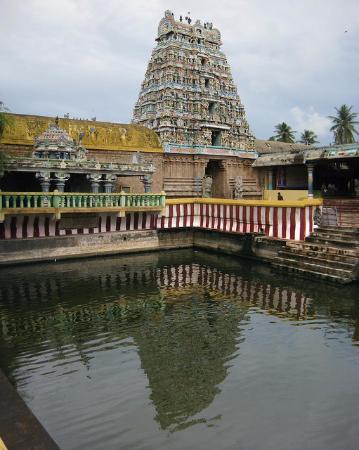
    Patteeswaram Thenupuriswarar Temple ancient temple is on the northern bank of the river Thirumalairayan. This temple is very big and is spread over a sprawling 4.4-acre temple campus. It has 4 main towers at all the four entrances. The historical names of this place are Mazhapadi, Patteecharam, Devivanam and Shaktivanam. Historically Patteeswaram comes in the border of the ancient city ‘Pazhayarai’ which was the capital of the Chola Kingdom before Thanjavur.

    The legend is that Patti, the daughter of the divine cow Kamadenu, worshipped the lord here. Hence this place gets the name Patteecharam (“Echaram” means temple in Tamil). The lord is praised as Sri Patteeswarar (Sri Thenupureeswarar in Sanskrit).
    It is believed that Goddess Parvathy had performed penance here. Devas came here in the form of trees and plants to protect her and make the environment green. Kamadenu sent her daughter Patti to assist Goddess Parvathy. Pleased with her penance, Lord Shiva blessed her with his darshan. In this darshan he was seen with his dreadlocks (“jadamudi”).

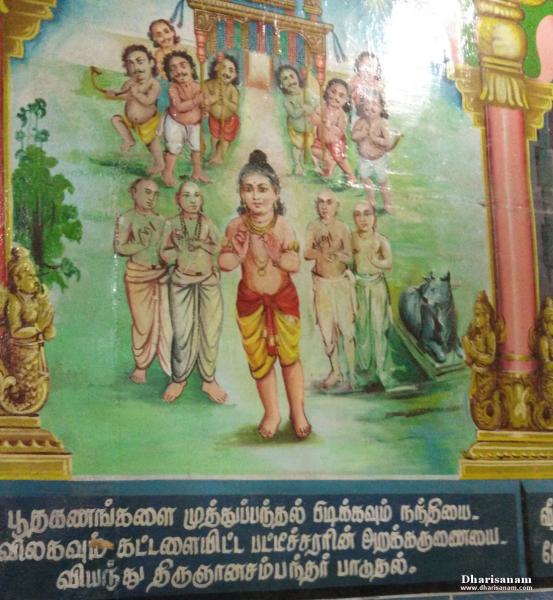
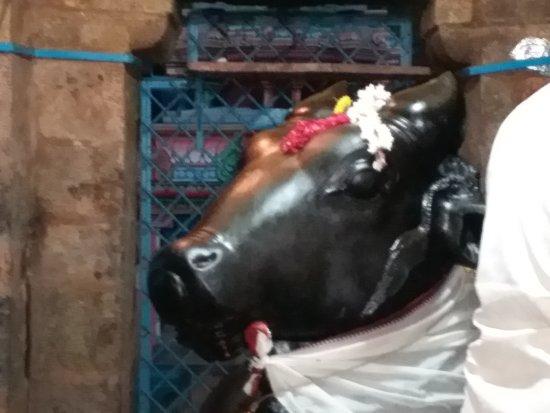
    Another legend is that Saint Thirugnanasambanthar, after worshiping the lord at Sakthi Mutram, a nearby Lord Shiva temple, proceeded to visit this temple. It was a peak summer day and in order to protect him from the oppressive heat, Lord Shiva created a tent lined with pearls (“Muthu panthal”) and sent it through his attendants (“Bhootha ganas”). He also advised the Nandhi to move a little bit to the side so that he could see the beautiful sight of Sambanthar arriving through the pearls roof. Devotees can see the Nandhi in this temple is not straight to the Lord as seen in other temples.
    It is believed that Lord Rama worshipped Lord Shiva here to seek pardon for the sins (“Chayahathi dosham”) that he had accrued by killing Ravana, Vaali and others. This event is commemorated every year during the Tamil month of Margazhi (Dec-Jan). He created a well here and used this water to perform abhishekam to Lord Shiva. This well is known as “Rama Theertham” or “Kodi Theertham”. This Theertham is considered to be equivalent to “Dhanushkoti Theertham”. Sage Viswamitra worshiped the lord here and it is believed that he attained the full power of the holy “Gayathri Mantra” and also received the title of “Brahma Rishi” in this temple.


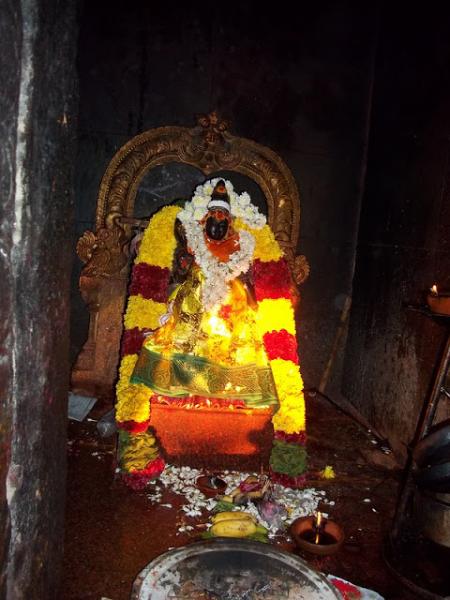
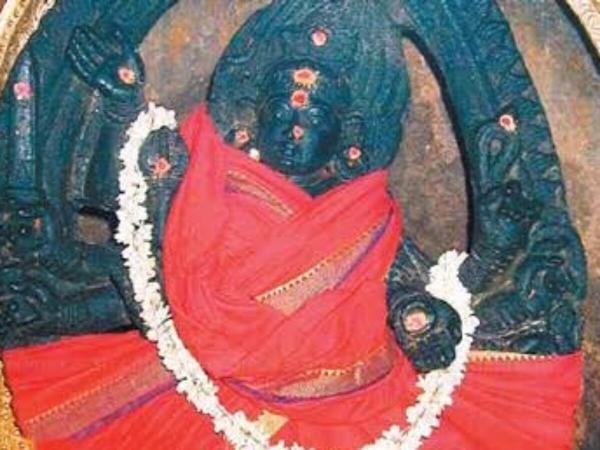
    Goddess Vishnu Durgai’s shrine, located at the northern entrance of this temple, is very popular among devotees. This temple is also known as Durgai Amman temple. The Idol of Mother Durga was originally placed inside the Pazhayarai Fort and worshiped by Chola Kings every day. Chola kings including the great Rajaraja Chola I were staunch devotees of Goddess Durgai. She was the guardian and advisor of Chola dynasty and Chola Kings used to get her permission (“Deiva Vaakku”) before going to war or taking any important decision. She is also known as “Kottai Vayil Durgai”. After the decline of the Chola empire, the idol of Durgai Amman was installed in this temple.
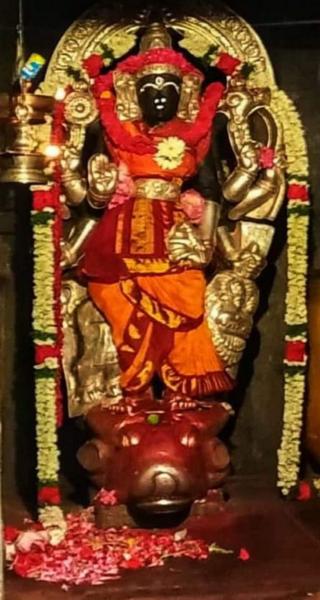
    The Goddess here is known by many names such as Vishnu Durgai, Durga Lakshmi, Navayoga Nayaki, Navakoti Nayaki, Navagraha Nayaki, Navaratri Nayaki and Navasakthi Nayaki, to name a few. Unlike in other temples, Goddess Durgai here has a pleasing appearance (“Shanta Swarupi”). She appears in a Thribanga stature – with eight hands, three eyes, wearing ear rings (“kundalam”) and standing on top of the demon Mahishasuran. Generally, her mount (lion) looks towards the right side whereas here it faces left.
    Devotees worship Lord Shiva of this temple to seek the blessing of prosperity and wisdom. Devotees can get relief from the adverse effects of planets Raahu and Kethu by worshiping Goddess Durgai here. Devotees pray to Lord Bhairavar here to seek relief from enemy threats and for cure from dog bites and other ailments.
     

  • Thiruvalangadu Vadaaranyeswarar Temple

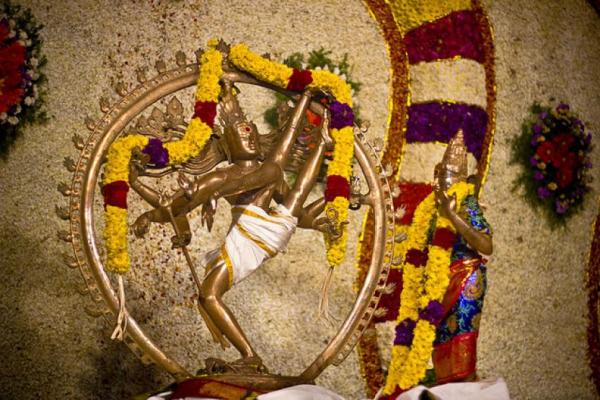
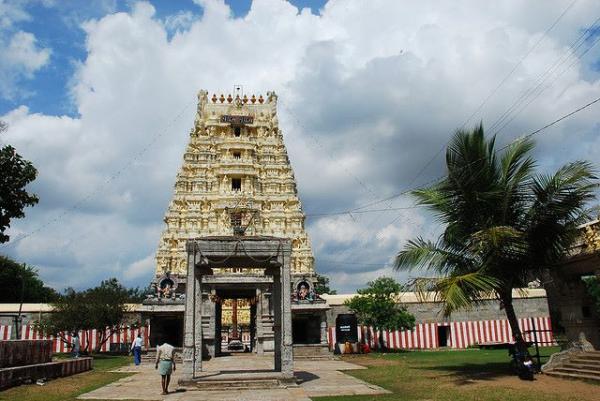
    There are 5 temples known as Pancha Sabhas, where Lord Shiva did the cosmic dance. Thiruvalangadu Vadaaranyeswarar temple is one of them which is called Rathna Sabhai. This temple is situated in Thiruvalangadu which is a small town in between Arakkonam and Thiruvallur districts. Vadaaranyeswarar Temple is one among the Padal Petra Sthalams in Thondai Mandalam (Northern Tamilnadu) which is mentioned as Thiruppazhayanur in Tevaram.

    Through the evidences of inscriptions, Sri Vadaaranyeswarar Temple dates back to 5th century. Later in 12th century this temple is enovated and extended by the Cholas. Main deity of this temple Lord Shiva is called Vadaaranyeswarar (God of northern forest) or Alavananathar (God who lives in banyan forest). Parvathi Devi in this temple is called Vandarkuzhali or Alavana Nayaki. Banyan tree is the shala vriksha of this temple.

    Legend says that, two demons Sumba and Nisumba chose this banyan jungle for their stay and began harassing the Devas. Devas appealed to Mother Parvathi for protection. Mother Parvathi appeared as furious Kali and destroyed the demons. Kali consumed the blood of the demons and their army and grew more furious. At the request of Sage Munjikesa Karkodaka, Lord Shiva reached the place. Kali challenged the Lord for a dance and said that she would give her right in the place to the Lord if he won. The dance began. Lord dropped his ear ring on the ground, picked it by the toe of his left leg and fixed it back on his ear in the dance. Kali accepted her defeat and said that she could not do such a marvellous dance. Lord Shiva said that he alone was equal to her and said further that those coming to worship him in this temple should worship her first to reap the full benefit of the worship. Since then, Kali has her own temple to grace the devotees.

    It is in this temple that Lord Shiva addressed the Great Saint devotee Karaikkal Ammaiyar as "Ammaye". Ammaiyar reached this temple by head as she thought walking by feet to Lord’s shrine was a sin. Ammaiyar even enjoyed the dance performance of the Lord standing upside down. She reached the state of bliss here.

    This is a very important temple for classical dancers as they worship here to master the art. Margazhi Thiruvadhirai (in the month of December-January) is the most important festival of this temple.

  • Parvathamalai Malligarjuna Temple

    Parvathamalai is one of the most sacred and lesser-known places in whole India, where a temple for Lord Shiva which was set up by Siddhars in the hill top to meditate and attain enlightenment. Parvathamalai is situated in the outskirts of Thiruvannamalai district. The ancient name of this place is Navira Malai, as mentioned in Sangam Literature which means king of all mountains.

    It is said that Parvathamalai is the spot of hidden supreme powers were lots of miracles happen. Many pilgrimages have witnessed the darshan of Siddhars in this mountain. Main deity of this temple is Lord Shiva in the name of Malligarjuna and his consort Parvathi is called Brammarambal or Akilandeshwari Amman. This Lingam was established by Sidhdhar Bogar himself and conducted ceremonies for many years. Malaipadugadam, a Sangam literature written 1800 years ago mentions this mountain as Navira Malai and Lord as “Kaariyundi Kadavul” (God who took all the poison to save devotees). It also mentions that Emperor Nannan of Sangam era worshipped here regularly. So, it is evident that the temple dates back to 2000 years.

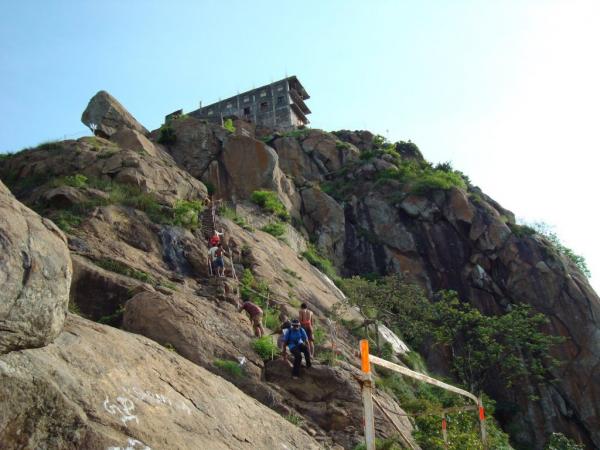
    One needs complete devotion to trek this 4500 ft mountain, as the steep is very difficult to climb. For trekking enthusiasts, Parvathamalai trek is sure to give a great experience since it contains many types of steps, boulders and odd steps to climb up the hill. One can reach the hilltop temple by two routes that combine in the half-way until the top. The two routes are the Thenmadimangalam route which is usually taken by the pilgrimages and Kadaladi route that is usually chosen by the trekkers since it is a bit tougher than the other route. There is one more route from Mambakkam that is very rarely used since it is very steep and its difficulty.


    Speciality of the temple is, anybody with devotion and belief can enter the sacred sannidhi of Lord Shiva and perform poojas, abishekam, aaradhana, alankara by touching the Holy Lingam. There is no door to the temple and is never closed at any time. Many pilgrimages used to stay in the night in the hilltop as they witness many suprising miracles. Many accept that they got the darshan of Siddhars performing pooja. It is believed that the smell of camphor, ringing bells and floral smells are the signs of Siddhars performing pooja. One can witness the miracle of Goddess Brammarambals face glows in the dark night of Ammavasai (no moon day), which is one of the divine mysteries of this mountain temple.

    This mountain contains many rare and beautiful flowers that bloom at night and there is a pleasant smell of the herbal flowers that heals one's mind and soul. Before one reaches the hilltop, there is a ruined fort that was built by king Nannan around 200 A.D, who was the lord of Cheyar and was the Chieftain of Chengam. This hill is steep and with different kinds of steps. One part of the hill is a path that contains rods called Kadaparai to hold and climb up the steep hill and hence this stretch of the mountain is called Kadaparai Malai (crowbar hill path). It is a natural wonder that it presents itself in different shapes from eight directions around the hill.


    There is an ashram that is located near Veerabhadrar Shrine at the foot of the hill, where one can get free food and the guidance of the route to the top. On the way, before reaching the hills there are temples dedicated to Lord Hanuman, Vinayagar, Pachai Amman along with 7 Muniswarar, Vana Durga and Lord Muruga. There is a Sannidhi outside Lord Malligarjuna Shrine, where there are idols of 18 Sidhdhas sitting around Shivalinga, which gives divine feel to all devotees.


    The devotees and the pilgrimages who are visiting the temple believe that the lord relieves them from all the sorrows of life and helps to walk into the path of enlightenment. The lord Shiva shows the way in each step of this mountain. Chant the mantra Om Namah Shivaya, to reach the top with power in mind to climb up and seek his blessings.


  • Vedaranyeswarar Temple

    Vedaranyeswarar Temple is a temple dedicated to Lord Shiva, located in the town of Vedaranyam in Tamil Nadu. Vedaranyeswarar temple is revered in the 7th century Tamil Shaiva canonical work, the Tevaram, written by Tamil saint poets known as the nayanmars and classified as Paadal Petra Sthalam. This is the only temple to have found mention in all the seven Thirumurais (Chapters) of Tevaram. Vedaranyeswarar temple is famed for the legend between Appar and Sambandar, when the former sang to open the door while the latter sang to close the door.

    The presiding deity of this temple is Thirumaraikadar (Vedaranyeswarar) and his consort Parvathi is called as Marainayagi (Vedanayagi). Vedaranyeswarar temple is a part of the series of temples built by Aditya Chola (871-907 CE) founder of Medieval Chola Dynasty along the banks of river Kaveri to commemorate his victory in the most famous Tirupurambiyam battle (which changed the course of south Indian history). It has several inscriptions dating back to the Chola period. Paranjothi Munivar, a 13th-century saint, who wrote the book ‘Thiruvilaiyadal Puranam’, was born in Vedaranyam.

    The town Vedaranyam is named after Vedaranyeswarar, the presiding deity of the temple. The place was earlier known as "Tirumaraikadu", meaning the place where Vedas originated. Appar and Tirugnanasambandar mentions the place as "Tirumaraikadu" in Tevaram. As per legend, the Vedas worshipped Shiva in this place, giving the name "Vedaranyam" to the place. According to another Hindu legend, Rama, the seventh avatar of god Vishnu, is believed to have worshipped Vedaranyeswarar to absolve himself from the sins committed in the war against the Ravana. The footprint of Rama is preserved in a place called Ramar Padam near Vedaranyam.

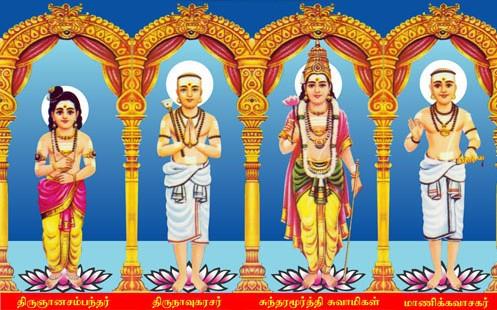
    Tamil legends says that, on their journey to various Shiva temples spread over the state, celebrated nayanmars Thirugnana Sambandar and Thirunavukkarasar (Appar) came to Thiru Marai Kadu Temple. They were shocked to see that the main entrance of this temple was closed and saw devotees entering the temple through a side entrance. They were told that the Vedas worshipped Lord Shiva here and returned after closing the door. Hearing that Gnanasambandar requested Thirunavukkarasar to sing a hymn on Lord to open the doors. Thirunavukkarasar, with tears flowing from his eyes sang ten verses beginning with line “Pannin Ner Mozhiyal” and begged Lord to open the doors of the temple. The doors opened and both entered the temple through the main entrance and worshipped the Lord. While coming out, Appar wished Gnanasambandar to sing a hymn so that doors could be opened and closed for the daily worship of the devotees as in all temples. Child saint Gnanasambandar sang a Pathigam of 10 verses beginning with “Chathuram Marai” closing the door. Since then, main doors of temple began to function in usual manner as in other temples.

    Vedaranyeswarar temple (Thirumaraikadu) is one of the Saptha Vidanga Sthalams (seven dance moves of Lord Shiva). Like Veedhi Vidangar in Thiruvarur does Ajaba Natanam during procession, Bhuvani Vidangar in Vedaranyeswarar temple does Hamsapaada Natanam. It is believed that if one take bath in Manikarnika Theertham in this temple and worship Thirumaraikadar and Marainayagi in this temple all hardships caused by sins are vanished.

  • Thiruvathigai Veerateeswarar Temple

    Thiruvathigai Veerateeswarar Temple is one of the 275 prominent temples (Padal Petra Sthalangal) dedicated to Lord Shiva. It is situated in Thiruvathigai village which is about 2 kilometres east from the town of Panruti. Shiva is worshiped as Veerattaaneswarar, and his consort Parvati is depicted as Thiripurasundari in this temple. This temple is considered the place where the Saint poet Appar (Thirunavukkarasar) converted back to Saivism from Jainism and attained final salvation.

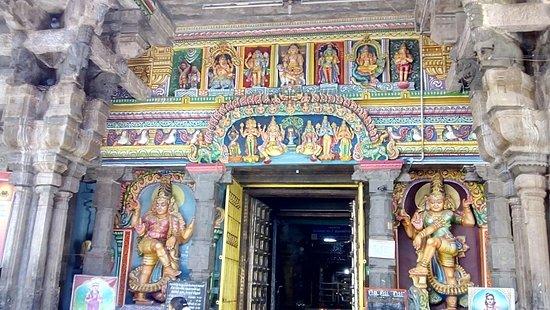
    The temple complex is one of the largest in the state and it houses two gateway towers known as gopurams. The temple has numerous shrines, with those of Veerateeswarar and Thiripurasundari being the most prominent. The temple complex houses many halls and three precincts. The temple is maintained and administered by Thiruvaduthurai Adheenam, a South Indian monastic institution.

    Legend holds that this temple is the place where Shiva destroyed three rakshashas and the three cities created by them. Saranarayana Perumal, another name of Vishnu, is the one who gave the arrow to Shiva for killing the demons, whose temple is also located in the town, little easterly. Shiva Purana details the legend of destruction of the demon Tripuran, who was ruling Tripura. The destruction is detailed as a cosmic event, which most attribute to the destruction of stars, meteors and unexplained material bodies. Tripuran attacked all the celestial deities who sought the help of Shiva to protect them. Shiva after a fiery fight, destroyed Tripuran and attained the name Tripurantaka. Shiva ashed down the city Tripura and dipped his three fingers in the ashes, which signifies the three lines of ash which is worn by all shaivites on their forehead.
    As per another variant of legend, the three sons of Taraka obtained boons from Brahma and built an impregnable fortress on earth. On account of their atrocious activities, mother earth prayed to Shiva for rescue. Shiva burnt down the fort and was about to attack the trio, but they begged for mercy. He made two of them as Dvarapalas and one as his damaroo, which he sports in his right hand. The whole incident is believed to have taken place in Thiruvathigai on the banks of river Kedilam.
     
    The Pallava king Mahendravarman I converted from Jainism to Saivism under the influence of Appar. He is believed to have destroyed a Jain monastery and built a temple called Gunavareswaram close to the temple. Mahendra Pallava is believed to have attained the name Gunavareswara on account of the incident. A king called Kalinkaraya is believed to have endowed lot of treasures and built various structures in the temple as seen from the inscriptions in the temple. King Raja Raja Chola I is believed to have stayed in this temple for a long time to study the architecture before building Brihadeeswarar Temple.
     
    Appar's sister Thilakavathiyar settled here during her later years and devoted her lifetime service to Shiva. Afflicted by a painful stomach illness, Thirunavukkarasar, who was originally called Dharmasenar and was then a staunch follower of Jainism, prayed for relief at this temple where his sister Thilagavathiyar served. By the divine grace of Shiva, he was cured. He embraced Saivism from then and started canonizing various temples with his verses. The ruling Pallava king namely Kadava who was also a Jain, punished Thirunavukarasar in various ways and finally dropped him in a lime kiln. He was subsequently cast on the waters of sea, where he started floating and was pushed ashore in Thirupathipuliyur. It is believed that some of his best songs were sung at this time in praise of the presiding deities at Padaleeswarar temple and Veerateneeswarar temple. Thirunavukkarasar came back to Thiruvathigai from Thirupathripuliyur. Influenced by the greatness of the poet, the king himself converted to Shaivism. Appar venerated Veerateeswarar in seventeen verses in Tevaram, compiled as the Fourth Tirumurai, Fifth Tirumurai and Sixth Tirumurai. The Soolai Kinaru, a well in the temple is believed to be the limestone well where Appar was dropped by the Jains. Though the actual location was in Cuddalore, the well is maintained as an indicative example of the event. The water from the well is taken by people suffering from stomach related ailments.
     
    Tirugnana Sambandar, a 7th-century Tamil Saivite poet and a contemporary of Appar, venerated Veerateeswarar in 46 verses in Tevaram, compiled as the First Tirumurai. According to the Hindu legend Sambanthar had a vision of cosmic dance of Shiva at this place.


  • Shiva, the Bholenath

    Lord Shiva, the destroyer in the Hindu Trinity is often described as one with rage – one who opens his third eye and burns down the enrager to ashes! But, there is a very soft, kind hearted Shiva, one less often spoken of.

    As we all know, Lord Shiva has many names by which his worshippers address him.

    Trinetradhari, Trishooladhari, Neelakantan, Someshwara, Jatadhara and so many more that a blog will be too (very, very) long just with his names listed. Dear Readers, in this article we speak of Shive, the Bholenath. As the name implies, He is an innocent one. All you need, to please him, is pure love and He, will shower you with blessings. Hence the name.

    Through the several legends, we learn that many so called Rakshas have been able to procure boons from Lord Shiva. Even in Sivapuranam, He is described as the kind hearted God, who heeds to the calling of the devotees.

    So, the next time you remember Rudra, make sure to think of Karunakara!

    To his devotees, He is a saviour, He is Thayumanavan – meaning one with maternal love!! Call out to him with love in your heart, you will realise that is as loyal to you as you are to him, Spread Love people and experience the divine.

  • The temple that relieves the burden of debts

    Every temple in Tamil Nadu has its own uniqueness. In that sense, the Tirucherai Senneriyappar Shiva Temple located in the Tanjore district is the temple that offers salvation to one’s economic struggle, especially, the debt problem.

    Tanjore district is located 15 km southeast of Kumbakonam. This Shiva temple is one of the south coast sites where songs were sung by the great saint-poets Thirugnanasambandar and Thirunavukkarasar.

    The name Senneriyappar is given to the Lord as it is the place where the man is blessed with the pearl of wisdom. The temple is also revered as the abode of Rinavimochanar, the liberator of man from debt problems. Rinavimochanar is the primary deity in the temple.

    And in a unique way that no other Shiva temple has, the Bairavar here is on display with a bell on his left upper arm. The three deities Siva Durga, Vaishnavi Durga and Vishnu Durga are also resident in this Holy place. Special pujas are performed for the deity on special days like Adippuram, Navratri, Kandharsashti and Pradosham. This temple is home to innumerable special features.