Siruvaburi Balasubramaniya Swami Temple is one of the most famous Murugan temples in Tamilnadu. It is believed that marriage related issues and problems in buying/constructing homes are solved if we pray Lord Murugan and his consort Valli in this temple (Parigara sthalam).
Siruvapuri is located about 40 kms from Chennai on Chennai Gumidippoondi highway. The temple is located about 3 km off the highway.
History of the temple has that Lava and Kusa, the sons of Rama lived in this place. Once when Rama was passing this place, they have fought a war with Rama himself without knowing that he was their father. As the young children waged a war here, the place was called as Siruvar Por Puri. (Siruvar means children, Por Puri means waging a war, in Tamil). This place is now called as Chinnambedu, which originally was Siruvar Ambu Edu meaning, children who took their arrows for the fight.
.JPG)
Some hundreds of years back there lived a lady called Murugammai in this village. She had been a very ardent devotee of Lord Muruga here. She always used to chant His name and praying Him, for years. Her husband who didn't like her worshipping all the time was warning her to stop it. But she never listened to him and her husband one day cut her arms off out of anger. Even then, Murugammai cried for help only with Lord Muruga. The Lord who was pleased with her devotion, granted her hands back without any trace of the wound.
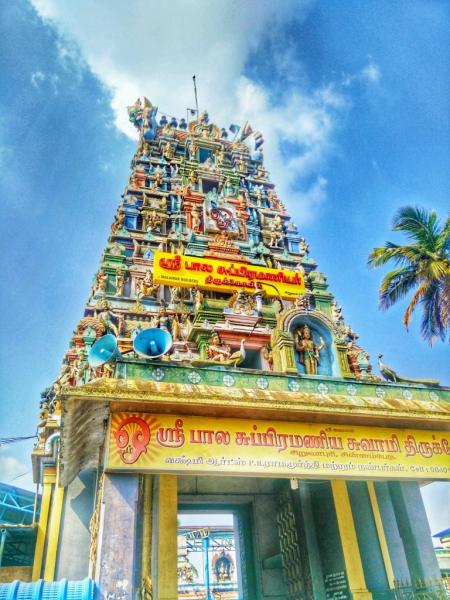
Lord Muruga here is called Srī Balasubramanyar and is said to be powerful, granting the wishes of devotees. This beautiful temple also has Srī Annamalaiyar (Lord Shiva) and Srī Unnamulai Amman.
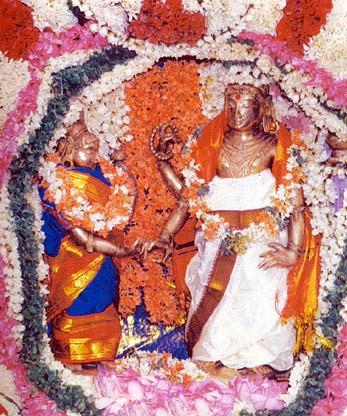
The utsava moorthy of Lord Muruga is seen as Valli Manalar in a wedding posture with Srī Valli. Lord Muruga here is believed to grant wishes for those intend to buy or construct a house. Many people who wish to buy a house visit Lord Muruga here for blessings to fulfill their wish.
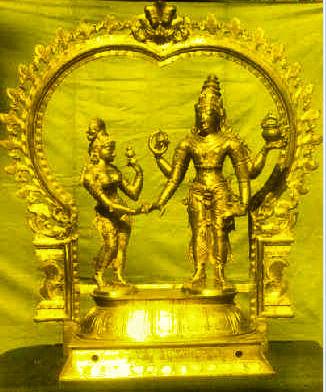
Among the various names of Murugan, the name Valli Kanavan stands supreme as the famous one. Murukan, who is the consort of Teyvayanai, the celestial daughter of Indra, married a huntress-girl of this human world, an aspect having very deep philosophical significance. All are equal in the face of God and this is the expression of the Vallinayakam form. Valli shines in brilliance here as Ichha Shakti.
The marriage of Murukan with Valli is eulogised by Tamil Sangam Literature scholars as a most fitting example of 'furtive love'. (Kalavu Vaazhkai). His image of wedlock with Valli is known as Valli Kalyana Sundarar in this temple. The Kumara Tantra depicts this form as having one face and four hands. The front two hands are one in abhaya mudrā and the other in Kadyavalmpitham (hand placed on the hip). In the back two hands he has Rudraksa mala and Kamandalam. In this form on the right side, we find Valli in all her beauty. Lord Murukan holding the hand of Valli in preparation for wedlock is only the one of its kind at Siruvāpuri Srī Balasubramanya Swami Temple.
The worship of Valli Kalyana Sundarar paves the way for the celebration of marriages at the proper time among families. Even marriages which have been thwarted by circumstances are said to get relieved of obstacles, paving the way for happy married life. The belief is to worship this Bridegroom of Valli on the Poosam star day, one gets married quickly, because it is said that the wedding of Valli and Murugan happened on the Poosam star day.
A unique feature of this temple is the Maragatha Mayil (Peacock) the carrier of Lord Muruga made of green emerald stone.
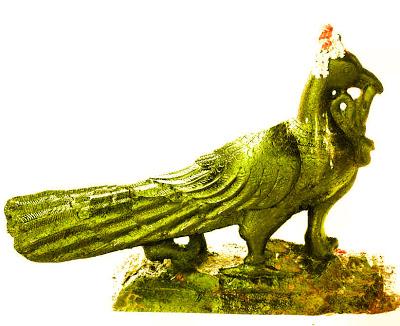
Arunagirinathar is seen just near the sanctum facing the Lord. Arunagirinathar has visited this temple and sung many Thiruppugazh songs here. He also has composed an Archanai Thiruppugazh on Lord Muruga, which if recited fulfils ones wishes. Other deities are Maragatha Vinayakar, Aadhi Murugar, Naagar, Venkatrayar, Muniswaraar and Bairavar.